

Looking for Pirates: From Rome to Vancouver to Kyushu
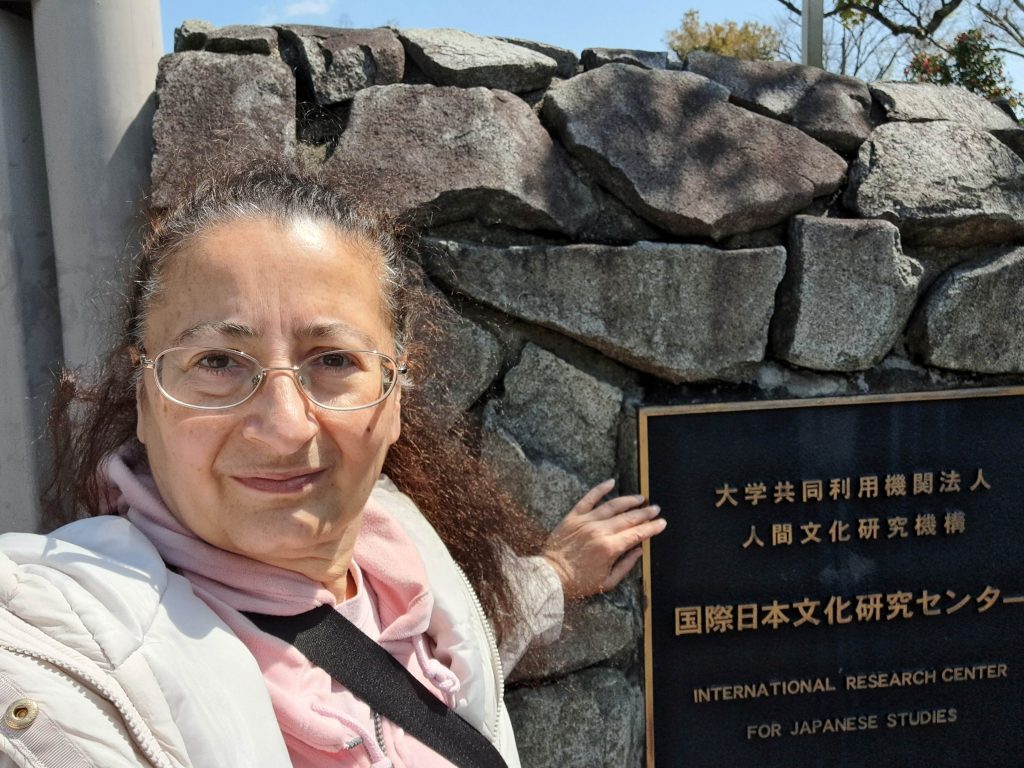
Maria Grazia Petrucci was a visiting research scholar at Nichibunken from April 2025 to March 2026 to conduct research on “The transformation of Japanese Piracy from the end of the Imjin wars to the Ming Qing transition.”
Dr. Petrucci received her doctoral degree from the University of British Columbia, Vancouver BC, Canada. She specializes in Sino-Japanese history, focusing on 16th century Japanese piracy in Kyushu, on the trade relations between Portuguese and Japanese Christians, and on the consequent conversion to Christianity of notable Japanese daimyō. She has been a researcher at the University of Kyushu, working on northern Kyushu pirates and corsairs. She is currently teaching East, Southeast Asian and Maritime History at a college in the lower mainland in Vancouver. Since 2022, she has been participating in the translation of Japanese medieval diaries with scholars of Japan Past and Present. In 2021, she began to delve into studies of classical Mongolian to read documents and conduct parallel research related to Inner Asian history. Her current research focuses on the microhistory of 16th century Japanese piratical activities in Asia.
What sparked your interest in Japan?
When I was about ten years old, my mother wanted me to learn a musical instrument, as many parents do, especially for girls. She asked what I would like to learn, and instead of choosing something typical like the piano, I said the harp. However, there wasn’t a harp school near our home in Rome, so she looked for an alternative and found a guitar teacher nearby, thinking it would be somewhat similar.
For about two years, I went to the teacher’s house for lessons. But what truly fascinated me was his wife, who was Japanese, and their home. Their home was filled with beautiful Japanese objects, textiles, and miniature landscapes. Instead of focusing on the guitar, I would look around, completely absorbed in these surroundings, and that was the beginning of my interest in Japan. I remember thinking, even as a child, that I wanted to learn more about this culture.
How did you come to Japanese studies?
When I was about 20, my father wanted to send me to university, but he said he would only support me if I studied political economy and commerce. That was not what I wanted to do. So, alongside university, I took on various side jobs and paid for a three-year college program myself, where I studied Japanese language, literature, and history. I was basically doing both at the same time, university in the morning and college in the evening, and I actually finished college first.
Then, I got a job at the Japan Travel Bureau. I worked there for a few years and got a real sense of Japanese work culture, long hours, strong commitment, and a big emphasis on hospitality. After that, I decided to move to Vancouver. I ended up working in the airline industry for several years. Then, around the time of the Asian financial crisis, I decided to go back to university. I did a BA in Asian Studies, then added another degree in International Relations. But in the end, I realized that what I really liked was history. So, I went on to do a master’s in Japanese medieval history, and from there, my professor encouraged me to continue to a PhD, which I did.
Did you have an opportunity to study in Japan, and how did it influence your academic journey?
In 2010, I was awarded a Japan Foundation fellowship, which allowed me to study in Japan. I spent a year in Kyushu and then extended my stay for another six months, teaching business English at Kyushu University. While I was there, I was suddenly told that my professor in Vancouver had retired. I returned to Canada, and learned that he was no longer able to supervise me due to health reasons. That was a stressful moment, as I had to rethink my plans. In the end, I found another supervisor and continued my research, which eventually led me to complete my PhD.
How did you come to your research topic about piracy?
During my master’s, I was initially interested in the sixteenth century, especially Japan’s contact with Europeans. I wrote my dissertation on the Christian daimyō Konishi Yukinaga (1558–1600), who is well known for his involvement in the Imjin War of 1592 prosecuted by Hideyoshi. At the time, it was difficult to access Japanese-language sources on Konishi Yukinaga in Canada, but I was very curious about his life. I thought that if I had been living in Japan at that time, I would probably never have converted to Christianity, so I wanted to understand him more deeply. During my research, I discovered that Konishi had connections with pirates in the Seto Inland Sea, and that was the point when my interest in piracy really began. I want to deepen this topic more, because I think some temples somewhere must have relevant documents!
Did you have any difficulties when doing your research in Japanese archives?
I have done research in many archives. It can be quite difficult to access the documents, and sometimes you need special permission to take copies. I think there should be more openness in Japan, especially for postgraduate researchers.
What is the state of Japanese studies in Canada?
In Canada, there are several universities with strong programs in Japanese studies. One of them is the University of British Columbia (UBC), where I did my studies, and it has a very important library collection. When I was there, Japanese literature was the predominant focus, but more recently, there has been a growing interest in popular culture, especially manga.
At UBC, there is a chronological division between the Department of Asian Studies and the Department of History. Asian Studies focuses on earlier periods, up to around the sixteenth century, while the seventeenth century onward is studied in the History Department.
What challenges do you face in teaching?
Nowadays, one of the biggest challenges is AI. For example, I once assigned an essay asking students to explain the maritime history of Japan chronologically, but instead, I received a couple of essays that were about European maritime history! There are issues about students’ use of AI and how we can encourage them to engage more critically.
What is your message for PhD students?
There are still so many areas to explore, so my message is this: Don’t give up. Keep digging, and something will emerge.